Sunday, 11 October 2009

Opium Dens


Links to film extracts involving opium dens (to be taken with a pinch of salt)...
http://www.youtube.com/watch?v=Gwnw-lsyQYA&feature=related
http://www.youtube.com/watch?v=tqrBGk-Qrqo&feature=related


Shows exactly how to do opium...
http://www.youtube.com/watch?v=WdCExHcEUP8&feature=related


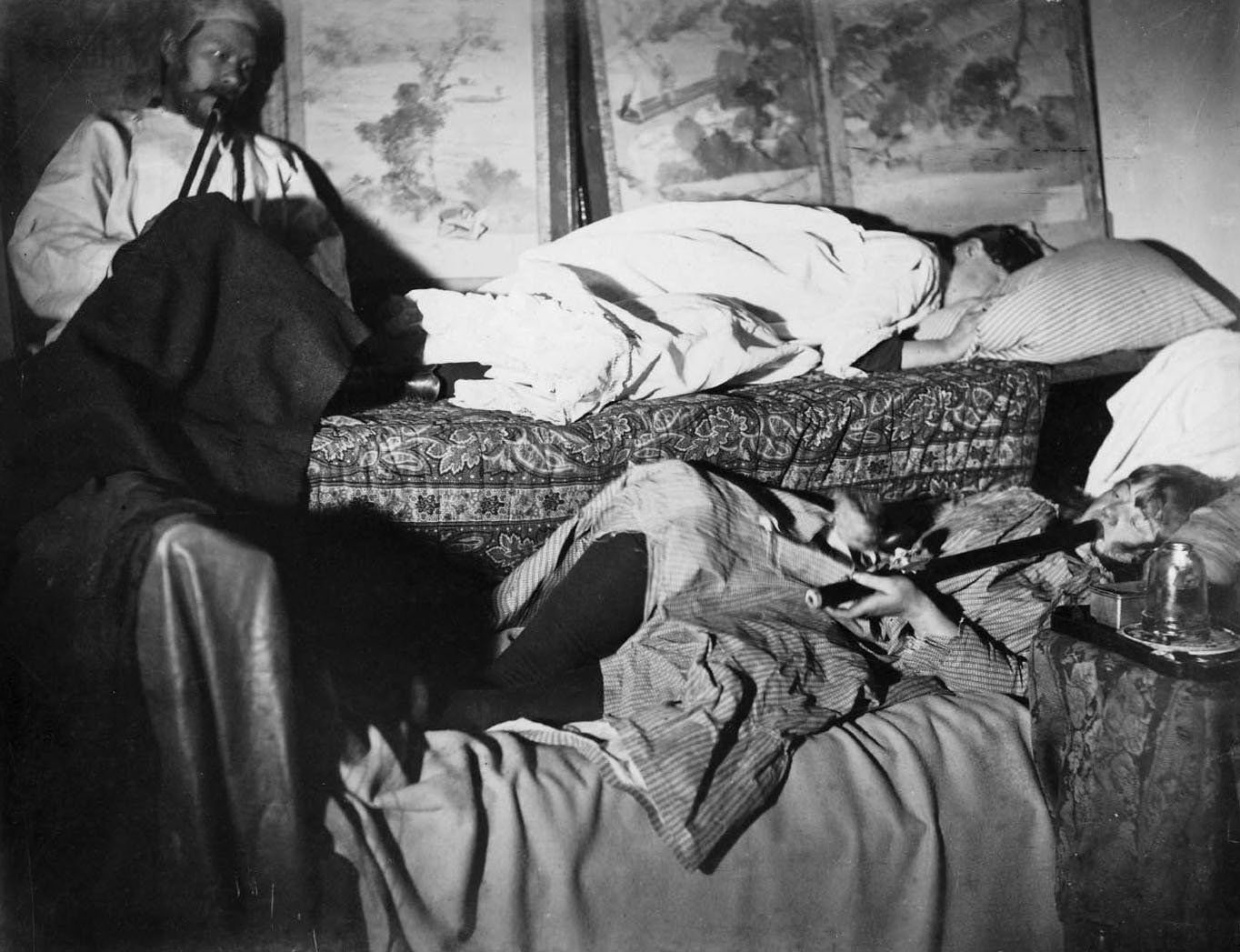
Opium pipes:
An opium pipe is a pipe designed for the vaporization and inhalation of opium. True opium pipes allow for the drug to be vaporized while being heated over a special oil lamp known as an opium lamp. It is thought that this manner of "smoking" opium began in the seventeenth century when a special pipe was developed that vaporized opium instead of burning it. [1]

The configuration of the typical opium pipe consists of a long stem, a ceramic pipe-bowl, and a metal fitting, known as the "saddle", through which the pipe-bowl plugs into the pipe-stem. The pipe-bowl must be detachable from the stem due to the necessity to remove the bowl and scrape its insides clean of opium ash after several pipes have been smoked. The stems of opium pipes were usually made from bamboo, but other materials were used such as ivory, silver and jade, to name a few. Pipe-bowls were typically some type of ceramic, including Yixing clay and blue and white porcelain. Sometimes opium pipe-bowls were carved from more valuable materials such as jade.

Because of its design, the opium pipe needed an opium lamp in order to function. The lamp was as highly specialized as the pipe, and was designed to channel just the right amount of heat upon the pipe-bowl so that the opium would vaporize and allow the smoker to inhale the intoxicating vapors.


Really good quote from the Sherlock Holmes story, The Sign of Four...
Holmes justifies his recourse to recreational drugs to Watson in these words: “I find it… so transcendently stimulating and clarifying to the mind that its secondary action [i.e. whatever damage it might be doing him] is a matter of small moment… I abhor the dull routine of existence. I crave for mental exaltation.”


Thomas De Quincey's descriptions of opium from his Confessions of an English Opium-eater...
The Pleasures
"Oh! just, subtle, and might opium! that to the hearts of poor and rich alike, for the wounds that will never heal, and for 'the pangs that tempt the spirit to rebel,' bringest an assuaging balm; eloquent opium! that with thy potent rhetoric stealest away the purposes of wrath; and to the guilty man, for one night givest back the hopes of his youth, and hands washed pure of blood...."

De Quincey describes the long walks he took through the London streets under the drug's influence:
"Some of these rambles led me to great distances; for an opium-eater is too happy to observe the motions of time. And sometimes in my attempts to steer homewards, upon nautical principles, by fixing my eye on the pole-star, and seeking ambitiously for a north-west passage, instead of circumnavigating all the capes and headlands I had doubled in my outward voyage, I came suddenly upon such knotty problems of alleys, such enigmatical entries, and such sphinx's riddles of streets without thoroughfares, as must, I conceive, baffle the audacity of porters, and confound the intellects of hackney-coachmen."

Hope this helps
Charlotte xx

Freak show links

Hey all!

Here are some links about freak shows, circus in victorian times...enjoy!

http://www.nfa.dept.shef.ac.uk/history/shows/freaks.html
http://listverse.com/2009/08/29/top-10-creepy-aspects-of-victorian-life/
http://www.victorianlondon.org/entertainment/freakshows.htm
http://www.channel4.com/life/microsites/B/bornfreak/show1.html
http://www.cambriapress.com/cambriapress.cfm?template=4&bid=351

Josie xx

Saturday, 10 October 2009

Marionette Movements

Links to help learn how to move as puppets:
http://www.youtube.com/watch?v=v2Y2PUjp7AY&feature=channel
http://www.youtube.com/watch?v=xgUT118dDjo&feature=related

This is amazing and so helpful
http://www.youtube.com/watch?v=ke1pEordbRk&feature=related

Charlotte xx

Friday, 9 October 2009

Whatever

Hatty practicing blog

moving forward

Hey :) am very encouraged now by the extra's I've seen happening outside of sessions even just today! Don't forget your research coz you'll need it to help fill out your character histories or 'back stories' as your developing the realistic scenes.

Victorian Speech!

Everybodies gotta practise talking like a Eliza Doolittle! :D

Cockney deviated from Standard Speech mainly through pronunciation. As observed in numerous novels by Charles Dickens, the lower classes adapted to the cockney style. This includes,

•Dropping the “h’s” before words such as “head” to sound “ ‘ead.”
•Swallowing vowels such as “e” in “fowld” as opposed to “fowled.”
•Slurring vowels to produce “I believe yer” as opposed to “I believe you.” This later became native to Manchester and Liverpool, areas north of London.
•Most prominently “t’s” were replaced by “uh” to transform “butter” to “bu’er.”
•The “v’s” were replaced with “w’s” such as in “werry” as opposed to “very.”

Basically, try watching 'My Fair Lady' and pay particular attention to how Eliza speaks before Henry Higgins gets hold of her. It'd also be a good idea to watch this film as it is generally based around speech. Although the film was based in Edwardian period. The language is not very disimilar to what we would be speaking in the Victorian era.

Standard Speech
The aristocrats and gentry spoke Standard Speech yet still formed their own slang. However, this slang was not pervasive to the English language, as cockney was thought to be, but instead was primarily regional and an upper class prerogative.

•Members of the upper class concentrated on correct pronunciation.
•The term “gentleman” was thought to be too inappropriate and was “passed down to the lower classes” (Phillipps 8). Thus “ladies and gentlemen” was replaced with “ladies and men” (Phillipps 8). This replacement was justified because the word “gentleman” created an impression of unctuousness which was unfavorable. It thus became too informal of a term to use amongst such high caliber.
•Speech was very much characterized by “slow, drawling speech” in order to express an attitude of laziness and languor: an effortless attempt at perfection (Chapman 172).
•Some upper class slang replaced “r” with “w” as opposed to the v/w exchange in cockney. For example, “Gwacious Heavens!” (Chapman 172).
•Prominent upper class language is usually metaphorical, expressed with confidence and vitality to convey the upper class privilege.

Occupational Speech (Middle Class)

•Many slang terms were invented by University students, such as Oliphant’s example in Phoebe Junior. Clarence Copperhead has been “plucked” or has been expelled from Oxford. Sir Robert conveys a strong dislike to the usage of this slang, a characteristic of his upper class status
•It was said that one was going “up” to Oxford or Cambridge and going “down” to London (Phillipps 44).
•Occupations such as schoolmasters, legal positions and doctors all required slight usage of technical terms incorporated into speech. For example, in Our Mutual Friend, the narrator portrays that Mortimer Lightwood is an intelligible man of his occupation who can say the word ‘affidavit,’ yet Rogue Riderhood mispronounces it as an “Alfred David” (Dickens 12).

Therefore, language in the Victorian era was important in ranking members of classes and occupations. Language had the potential to assess and reflect upon one’s regional, educational, occupational and family background.

I found all this information here :
http://www.clas.ufl.edu/users/agunn/teaching/enl3251_spring2005/omf/KATARIA.htm
It seems quite useful!
Try it oooooout.
Tish x

Wednesday, 7 October 2009

Punch and Judy Script

Just a little something i knocked up to work on. Feel free to make any alterations you wish.

Act 1, scene 1


(Enter Judy)
Judy: Oh hello children, I did not see you there, I’m Judy
Children: Hello Judy
Judy: I’ve just made this lovely warm pie for my husband Punch. Would you like to try some?
Children: Yehhh
Judy: (Judy walks forward and drops the pie) Oh woops, I seem to have dropped this lovely pie. Mr. Punch will be very angry, don’t tell him will you children?
Children: Nooo…
Judy: I said, you won’t tell him will you children?
Children: Nooo!
Judy: Very well, shhh, I’ll just go and get a mop to clean it up with
(Exit Judy, Enter Punch)
Punch: (singing) My name is Punchinello
All dressed in red and yellow
I’m such a clever fellow
Rootitootitooit!
Rootitootitooit!
How de do de? I’m Mr. Punch
Children: Hello Mr. Punch
Punch: (Looks around) Where’s my wife Judy? Judy! Judy!
Judy: What is it Mr. Punch?
Punch: Judy how 'bout a kiss? Kissy! Kissy! Kissy!
Judy: No, Mr. Punch, you can’t have a kiss
Punch: I want a kiss now! You know how angry I get if I don’t get my kissy.
Judy: I know Mr. Punch, I know. Alright then but first I must blow my nose.
(Judy blows her nose on her apron. They then kiss in an exaggerated manner, spinning in circles etc.)
Judy: That’s enough, Mr. Punch
Punch: Where’s my pie then? (Directs audience) Do you know where my pie is?
Children: Nooo..
Punch: (Points to individual person in the audience) Do you know what happened to my pie?
Charlotte: It’s on the floor
Punch: Judy! Why is my pie on the floor!?
Judy: I’m sorry Mr. Punch I dropped it by accident.
Punch: That’s a very bad thing to do Judy. (Takes mop from Judy’s hand and starts hitting her with it.)
Judy: Ow! Ow! Ow! ( Judy moves to downstage left whilst being hit by Punch and finally slides off stage)
(Enter constable, Punch hides mop behind his back)
Constable: Ello. Ello. Ello. What’s going on ‘ere then? Mr. Punch have you been hittin’ Judy again?
Punch: Nooo..
Constable: Has he been hitting Judy, children?
Chidlren: Yeess
Punch: No, I haven’t
Constable: I’m sorry Mr. Punch I’m going to have to write this down in my notebook.
Judy: (Pops up) Help me, Constable
Punch: (Hits her back down again before Constable turns around)
Children: Laugh
Judy: (Pops up again)
Children: Look Constable look!
Punch: (Hits her back down before the Constable turns around)
(Repeat)
Constable: Right that’s all written up. Don’t let it happen again please, Mr. Punch. Do you promise?
Punch: (Nods)
Constable: Cheerio then.
Judy: Ow. that wasn’t a very nice thing to do Mr. Punch. (Babie cries) Now look you’ve gone and woken the baby up, I must go and look after him.
Punch: Hehehehe (Punch laughs)
Judy: (Quickly returns and thrusts the baby into Punch’s arms) Here you are, Mr. Punch, I want you to look after the baby, I must go and make another pie. Make sure you don’t wake him.
(Exit Judy)
Punch: (Puts baby down downstage left and goes back over to downstage right) Walky, Walky, Walky. ( He looks at the baby but it doesn’t move)
Punch: Walky, walky, walky (He walks toward the baby clapping his hands, When the baby doesn't respond he does it again this time walking along the play board with his hands as if to show the baby what to do.)
Punch: Walky, walky, walky
Punch: Stupid baby! ( Punch kicks it to the other side of the stage and it starts crying)
Punch: Where’s the baby? Where’s the baby? (He picks it up) What? What a noisy baby! (He starts banging it on the stage) Quiet baby! Noisy, naughty baby!
Children: (laugh)
Judy: (From offstage) Have you woken the baby, Mr. Punch?
Punch: (Throws the baby into the crowd where one of the children catches it)
That’s the way to do it! Roottitoottitooit!
Judy: (Enter Judy looking for the baby. She looks around the side, over the edge and even up in the air. Punch is looking very sheepish at the side of the booth.)
Judy: Mr Punch. Where is the baby? What’s happened to the baby?
Punch: He was such a noisy baby
Judy: Mr. Punch, what have you done with the baby?
Punch: He went walky,walky, walky and fell out the window. [Punch uses his hands to mime the walky action along the stage.]
Punch: Where’s my pie?
Judy: It’s just here Mr. Punch (Judy reaches behind her and has another pie)
Punch: (Smashes the pie to the floor) I don’t want pie anymore. I want sausages.
Children: (laugh)
(Punch and Judy exit with Punch hitting and kicking Judy)

Punch and Judy

Here are a few links on Punch and Judy:
This Jan Svankmajer P&J show is really very creepy, creates a feeling that I think we ought to try to incorporate in ours. The beginning and ending are also very clever:
http://www.youtube.com/watch?v=Z1orgv9WKn4&feature=related

This version uses actual people so is very useful in seeing how the characters might move:
http://www.youtube.com/watch?v=yl0EP3buC3s&NR=1

Example of Punch's voice
http://www.youtube.com/watch?v=lmRkG1-4CjM&feature=related

History of Punch and Judy
http://www.youtube.com/watch?v=PnUCoDsFH4A&NR=1&feature=fvwp

A Punch and Judy Show
http://www.youtube.com/watch?v=Kk2AWrmITYc&feature=related

A typical Punch and Judy Script
http://www.punchandjudy.com/cvdcscript4/page10.html

PUNCH ORIGINALLY SYMBOLISED BRITISH POLITICAL SATIRE

Charlotte xx

Wednesday, 30 September 2009

Some Victorian Murder Stories

Victorian Murder Cases:
15/12/1856
Robert Marley – London


A murder almost at the seat of government occurred on October 20th, 1856, when a robber bludgeoned to death Robert Cope, manager of a jeweller’s and “curiosity” shop in Parliament Street, London.
A passer-by was alerted when he heard moaning from inside the shop A group of men gathered on the pavement told him dismissively: “Don’t worry. It’s just a couple in there quarrelling with each other.”
Not satisfied, the passer-by went into the shop and found Robert Marley, 39, beating Mr. Cope over the head with a 14-inch long life preserver. He rushed outside shouting for help, only to find that the group of men had vanished.
Marley ran from the shop but was caught by other passers-by and was charged with assault and robbery. A fortnight later Mr Cope died from his injuries and Marley was tried at the Old Bailey for his murder.
The court was told that the murder weapon was found alongside George Canning’s statue in Parliament Square. Marley had been transported in 1853 for burglary, and had only recently returned to London.
The accused agreed that he had struck Mr. Cope during the course of the robbery, but claimed that his victim actually died of lung disease. The jury didn’t accept that, and he was hanged on Monday, December 15th, 1856, outside Newgate Prison, before “an unusually large concourse of persons.”
No one ever discovered the identities of the men on the pavement for, expecting to be executed, Marley refused to name any of his accomplices.


Victorian Murder Cases:
11/12/1876
Charles O’Donnell – Chelsea, west London


The dinner guest was in a jaunty mood. He sat down at the table apologising for his wife’s absence, but remarking how pleased he was to be among the company. As the dinner went on, the guest, Charles O’Donnell, 57, said a few more things too, and from the way the conversation was going one or two of the other guests got the impression that there might be a sinister reason why Mrs. Elizabeth O’Donnell wasn’t there that night.
The O’Donnells, they remembered, were not the average sort of people you invited to dinner. O’Donnell had recently been released from a mental asylum. After that the couple had separated for a short time, then come together again, renting a room in Rawlings Street, Chelsea.
When the dinner was over one of the guests decided to call in at Chelsea police station. What he told officers there prompted them to call on O’Donnell. They found his room splattered with blood, and his wife lying dead on the bed. She had been battered to death with a pair of tongs that still lay bloodstained on the floor.
Charles O’Donnell, the man who came to dinner and had too much to say, was tried at the Old Bailey in November 1876, and was hanged on Monday, December 11th, 1876, at Newgate Prison.

Victorian Murder Cases:
16/12/1839
William Lees – London


“I am a murderer!” declared William Lees, a 35-year-old hairdresser, when he arrived at his sister’s house in Islington. When he told her how and why, she went with him by coach to his hairdressing salon in Chapman Street, Shadwell, in east London, where he lived with his wife Elizabeth.
There, just as he had said, was Elizabeth, 30, lying dead on the shop floor in a pool of blood. Her head had been almost severed by slashes from a razor.
Lees told his sister that he struck Elizabeth first with a piece of wood when they began to quarrel. He added that he had hidden a piece of rope inside his shirt because he intended hanging himself.
He had been an alcoholic from the age of 18. When he married he became very jealous of Elizabeth – once when she stayed out all night with friends he threatened to beat out her brains.
At his trial at the Old Bailey defence witnesses said that Elizabeth was often drunk too, and would frequently hit her husband. That plea failed to save him, and he was hanged on Monday, December 16th, 1839, outside Newgate Prison, before a crowd said to be “more numerous than normal but with fewer women present.”

November 13th
13/11/1849
Frederick and Marie Manning – Bermondsy, London


John Massey, a medical student, looked aghast when his landlord asked him: “Can a man under the effects of narcotics be induced to sign cheques?” What was going on, young Massey wondered? Surely the landlord wasn’t planning on robbing someone?
Before he could think of an answer, more questions came thick and fast: “What happens to someone when they are chloroformed?” and “What happens to someone who gets shot by an air gun?”
Massey had an inkling of the purport of the questions – he knew that Marie, the wife of the landlord, Frederick Manning, was having an affair with another man, and he knew that Manning knew about the affair. He didn’t want to be around if murder was going to happen, so he gave in his notice and left.
Murder, indeed, was what Frederick Manning, 30, owner of a beer shop, had in mind. He was tired of being cuckolded by Patrick O’Connor, an elderly Irishman of some means, and it seems that Marie, 28, was tired of her lover too. So on August 9th, 1849, they invited O’Connor to dinner at their home in Bermondsey, London, and Marie shot him through the head. Manning was to say later: “I heard him moaning in the kitchen. I never liked him very much, so I finished him off with a ripping chisel.”
They buried O’Connor under the slabs of the kitchen floor, and next day Marie went to her ex-lover’s house and took away bonds, shares, money and two gold watches. Manning was sent off to sell the shares, and raised £110. Next day Marie went back to the house to collect more securities, but this time Manning’s nerve failed, and he declined to sell the shares.
Marie, who was born in Switzerland, was furious. “You wimp!” she stormed. “What do I need a man like you for?” So saying, she stormed out of the house with all the stolen money, went to Euston station and took a train to Edinburgh.
O’Connor’s relatives, meanwhile, raised a hue and cry. The police went to the murder house, and discovered the body under the kitchen slabs. Marie was arrested in Edinburgh, and her husband, who had fled to the Channel Islands, was arrested in a village near St. Helier, Jersey.
At their trial the Mannings refused to look at each other, each blaming the other for the murder. Both were found guilty, and hanged on Tuesday, November 13th, 1849, in front of a vast crowd outside Horsemonger Lane Prison. In a moving letter to The Times, Charles Dickens, who was one of the spectators, denounced the levity of the crowd and the ritual of capital punishment.
Marie Manning wore black satin for her execution – a fact that caused black satin dresses to go out of fashion.

All nabbed from the website: http://www.truecrimelibrary.com/
These stories are really handy. They have tons more on ther as well, from differant parts of the UK.

Tish x
Wednesday, 23 September 2009

characters

WHEYYYY I CAN COMMENT!! thankyou tish :))
character idea list guyysss...

Pickpockets- brother and sister trying to get by without going into the workhouse.
Prostitutes- with personality. forced into the industry but afraid of it.
Painter- 'Posh lover' gets inspiration through absynthe and prostitutes.
Mickie Finn- has a stall on a market. (black market dealing)
Doctor- doctor who doesnt give a 'shit' about the patients.
Tommy Hat- Landowner of the pub and 'fancy man' (pimp) to prostitutes.
Snuff- significant yet subtle child who interlocks with all characters. (possibly a ghost) and draws images of what he witnesses but cannot speak.
Pandora- prostitute with money problems, prostitute of tomy hat.
Abby- was married in high class but has now become a prostitute due to leaving her hubby
Cynthia- sister to abby, a prostitute who is pregnant and needs to decide on an abortion or not.
Jonothan Carol- Former husband of abby, smuggles drugs from hospital.
Mary Carol- daughter of Jonothan, gets forced into drug habits.

:))
Leo

Friday, 18 September 2009

Okay so we're a little way into the devising now and we all have a jist of the kind of characters we want to play. ( I don't actually have a list so if someone could post one up that would be great)

A summerisation of the ideas we've had thus far:

- The guildhall presents the oppurtunity to have two main performances to be going on at the same time, the audience split into two to watch this and then change rooms during interval ( where will be acting out the streets of London)

- Interlinking storylines, are what we're trying to work on at the moment however I think its important to carry on with research whilst this is going on so we don't steer away from the facts.
a website I've found really great and has like loads of information on everything we need is:
http://www.victorianlondon.org/

- As everyone is aware there is the devising day with that group thingy on thursday, just a reminder to bring 5 pounds

anything I've missed out?

kat

Wednesday, 9 September 2009

2nd Lesson (Wednesday 9th September)

Summary of today's lesson:

Things to do: Visit Guildhall - space issues, lighting, mood (GROUP VISIT IMPORTANT)
Contact Sally Waters

Individual roles (to be decided by Friday):
Reuben - set design/performer Tish - performer/director
Josie - performer Charlie - performer
Amy - performer Charlotte - performer/director
Kat - performer/director Leo - performer
AJ - performer Callum - performer
Hatty - performer Cameron - set design/performer
Courtney - performer/director Victoria - ?


  • The Hat transforms for upper, middle and lower classes
  • Themes from Ghost Town --> area used to be thriving, descending into squalor
  • --> time periods; change in time
  • Promenade - set changes and scenery changes made easier
  • Narration? -->Landlady making audience move (FORM - practioner influence e.g. Brecht)
  • Changes in tone (contrasting themes/genre in each piece)
  • Audience arrives into piece -->dark dank atomsphere/upper class afternoon tea
  • A constant unchanging character e.g. the girl from Billy Elliot

CALLUM'S GROUP - GENRE

  • Comedy/dark --> mass contrast
  • Building process needed to create effective pathos scene
  • Audience needs an understanding of the characters to appreciate

REUBEN'S GROUP - CLASS

  • separation of classes doesn't work well e.g. one scene from each class
  • classes all present in one area e.g. kitchen staff, landlady, customers

TISH'S GROUP - TIME

  • murder mystery
  • looking back in time; periods in which stimulus stems from
  • -->2009/70s/20s-30s/Victorian

CORRUPTION OF POLITICS --> 2009 corruption present in V era still present

Steve speaks: "Powerful drama is a combination of the political and the personal, therefore the drama must mean something to the actors"

H/W: research corruption in 18th century

Charlotte

Sunday, 6 September 2009

Company Rules

Here are the rules we all settled on last term, any problems?

1. If you cannot make it to the lesson, post it on the absense thread of the blog

- A VALID illness- Something that will ail your acting ability
- Something that will spread ( swine flu)
- NO HANGOVERS
- Other issues: -Family/personal issues
- transport issues (post bus times on blog)
- Post on blog your work timetables

2. each company member should be aiming to post at least 1 every 2 weeks (place name at the bottom of every post)

3. Please try not to fall out (often) Seperate personal life and work

4. MAKE SACRIFICES: remeber your education is generally more important tha your social life, right?

5. FUEL yourself, the way YOU need to be fueled. EAT. DRINK. SLEEP

6. Wear black, BLACK CLOTHES we are not goths . we are theatre geeks

Kat

Sunday, 30 August 2009

Random ideas

Here are just a few random ideas i've come up with over the summer.

Firstly, I think that following the line that Charlie came up with of political corruption is a good way to go, as it links in with the stimulus e.g. the picture of london, the quotes as well as the flagellation of the black woman.

I also had an idea from the hat on the table. I thought that perhaps the hat could be a place, as in a pub or bar in which our characters meet. It can act also as a way of linking the pieces as a place for the characters to refuge. The Hat could also be either a seedy place for criminals or a gentleman's bar used by the unscrupulous gentry that cause the political corruption. Another idea was for The Hat to just be a pub but to be used by different classes, so each piece tells a story from each class; the lower, middle and upper.

That's all I've really got, see you all at school
Charlotte xx

Friday, 24 July 2009

hi all, hope u r having a good holiday so far....

been listening to the songs again and came up with a few ideas...
In ghost the lyric "All the clubs have been closed down," referred to the Locarno in Coventry which was a dance hall club in 1960s. perhaps we could have something similar maybe the club (or whatever) is a place where people take refuge to get away from what ever is happening above or in the real world... kinda like Cabaret (if anyone has seen the film)
ALSO...
there could be a narrator at the beginning and end whose a bit wierd and wonderful and has lived through whatever went on?
Play the songs when audience enters and leaves and we all wonder round hall (in character) when audience enters or just stand still like stauessing bits of ghost town either at end or in the actual piece just to create a atmosphere kinda what we felt when we first went into the drama studio (creepy, horrific, curiosity etc)
i really like the idea of it being set in old victorian times with death, plague, having a good time, corruption etc it would mean great costumes, make up and lots of different characters


so they r just some random thoughts if u wanna expand on them please do! and wanna tlk to me about them if you don't get any of them

Josie xx


Wednesday, 22 July 2009

Liking the ideas so far guys :) Evidently some good research going on, which as Mr. T will verify, is one of my favourites to push. Hey, don't forget the sounds and atmosphere.

Steve

Monday, 20 July 2009


Haha.

Anyway, the pandora's box idea could work, since i thought it might go hand in hand with the corruption and politics idea. Saying that the government could have something called 'Project Pandora' which could be a corrupt idea thats being planned by the government or leader.

Or, branching down the fantasy route, we have the real pandora's box, or something similar, that does open and does release some sort of horror, corruption, plague, famine or whatever you want onto the city/country (hence the picture with the starving man and the man who hung himself) and there could be one man (mack the knife?) who uses this to his advantage?

Im just throwing ideas about - writing my thoughts out. Anyone want to elaborate on the ideas feel free to do so... or just disregard them completely :P

- Cam

Sunday, 19 July 2009

an idea?

heyy =)
this is just a random idea that came to my head while i was thinking about all the ideas people were talking about, one of the main things that people seemed to be saying was the corruption of politics and one idea i had was to have 3 scenarios where the we how this 'corruption' has effected people in different situations. its just an idea but thought i would put it here to see if anyone can develop it furthur or something like that =)

there was talk of a pandora's box type idea which sounded cool, but i dont know where to go with that myself =(

Callum

Thursday, 16 July 2009